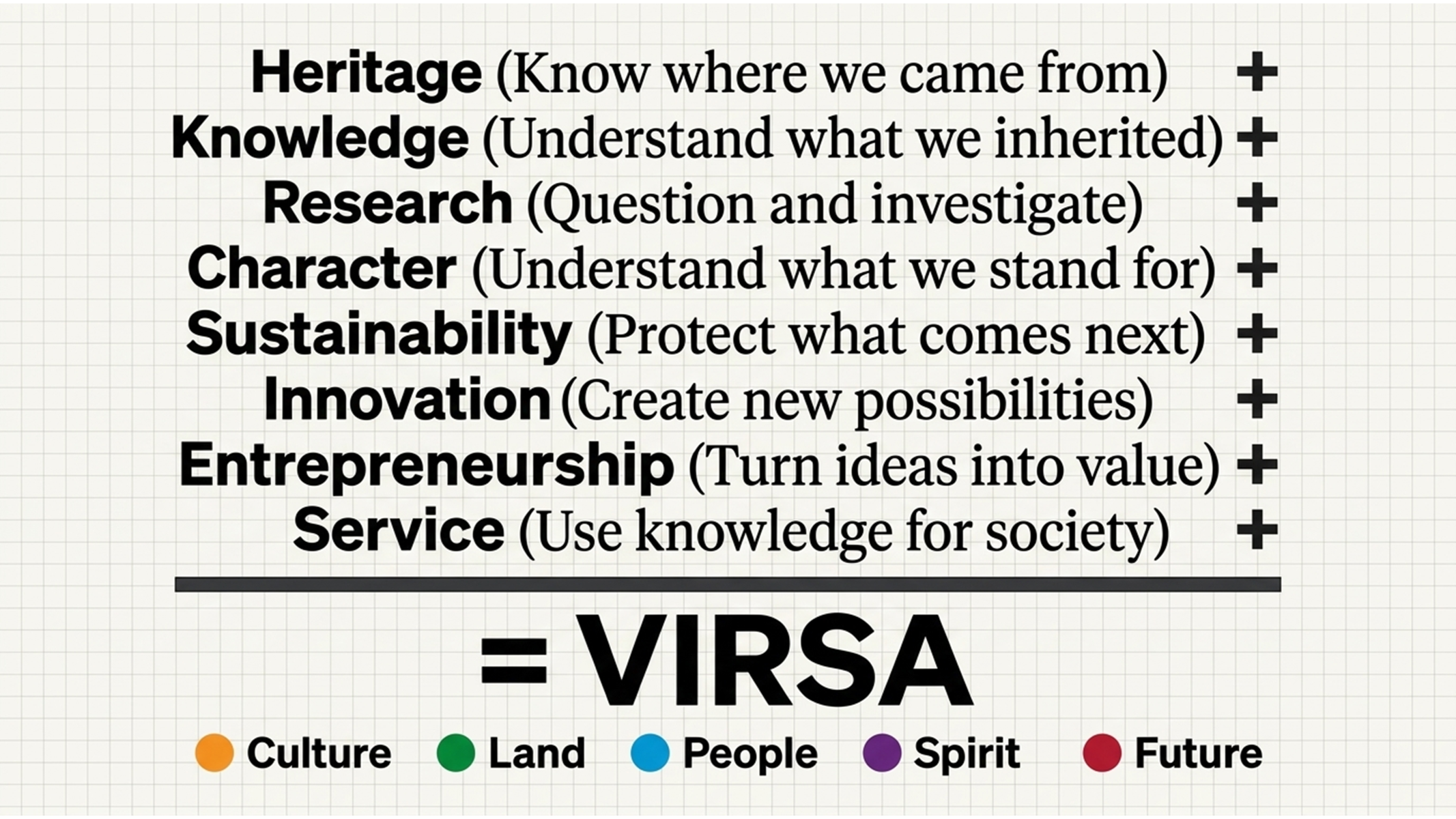
Two Years. Five Schools. One Global Heritage.
Learn. Research. Work. Create. Lead.
VIRSA – Global Punjabi Heritage Institute
Culture • Land • People • Spirit • Future
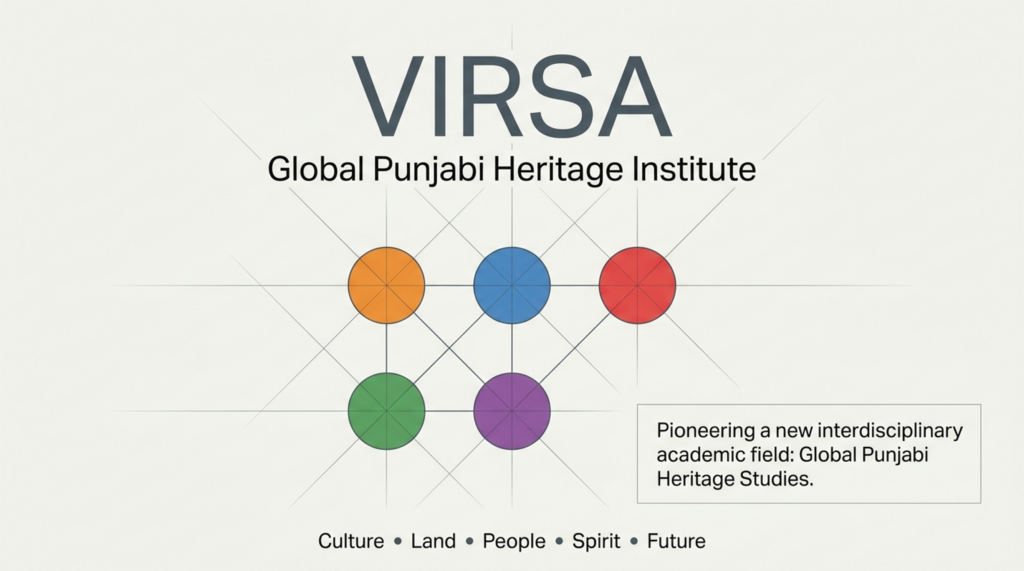
A POSTGRADUATE PROGRAM FOR THE FUTURE OF PUNJABI HERITAGE
Punjabi heritage is more than history.
It is language and literature.
It is music and Raag–Bani.
It is land, rivers and agriculture.
It is migration and diaspora.
It is family memory and genealogy.
It is social movements, leadership and seva.
It is architecture, food, folklore and living traditions.
And increasingly, it is digital archives, artificial intelligence, innovation and entrepreneurship.
The Post Graduate Certificate in Global Punjabi Heritage Studies at VIRSA is designed for learners who want to understand this heritage deeply – and help shape its future.
This is a two-year, 90-credit, multidisciplinary and work-integrated postgraduate program combining academic study, specialization, research, professional practice, entrepreneurship and a culminating Capstone.
PROGRAM AT A GLANCE
| Qualification | Post Graduate Certificate in Global Punjabi Heritage Studies |
| Institution | VIRSA – Global Punjabi Heritage Institute |
| Duration | 2 Years |
| Semesters | 4 |
| Credits | 90 |
| Level | Postgraduate |
| Semester 1 | VIRSA Core – 15 Credits |
| Semester 2 | Specialization – 15 Credits |
| Year 2 | Earn While Learn – 60 Credits |
| Specializations | 5 |
| Final Requirement | VIRSA Capstone |
| Learning Model | Academic + Research + Work + Innovation + Impact |
WHY STUDY GLOBAL PUNJABI HERITAGE?
Because heritage needs a future.
Much of the world’s Punjabi heritage exists across generations, countries, languages and technologies.
Some of it lives in libraries and archives.
Some exists only in family photographs and oral histories.
Some survives through music, poetry and performance.
Some is embedded in villages, rivers, farms and historic places.
Some exists in diaspora communities thousands of miles from Punjab.
And some is at risk of disappearing.
At the same time, new technologies create unprecedented opportunities to document, preserve, interpret and share this heritage.
VIRSA brings these worlds together.
From archival research to artificial intelligence.
From oral history to digital humanities.
From cultural preservation to entrepreneurship.
From classroom learning to professional practice.
THE VIRSA DIFFERENCE
Traditional heritage programs often focus primarily on historical or cultural knowledge.
VIRSA takes a broader approach.
KNOWLEDGE
Understand Punjab and global Punjabi heritage through interdisciplinary postgraduate study.
RESEARCH
Investigate history, culture, communities, language, environment and contemporary challenges using rigorous research methods.
PRACTICE
Apply knowledge through professional placements, research projects and community engagement.
CREATION
Build archives, educational resources, performances, digital products, technologies and ventures.
IMPACT
Create measurable educational, cultural, social, economic or environmental value.
THE VIRSA LEARNING JOURNEY
CULTURE → LAND → PEOPLE → SPIRIT → FUTURE
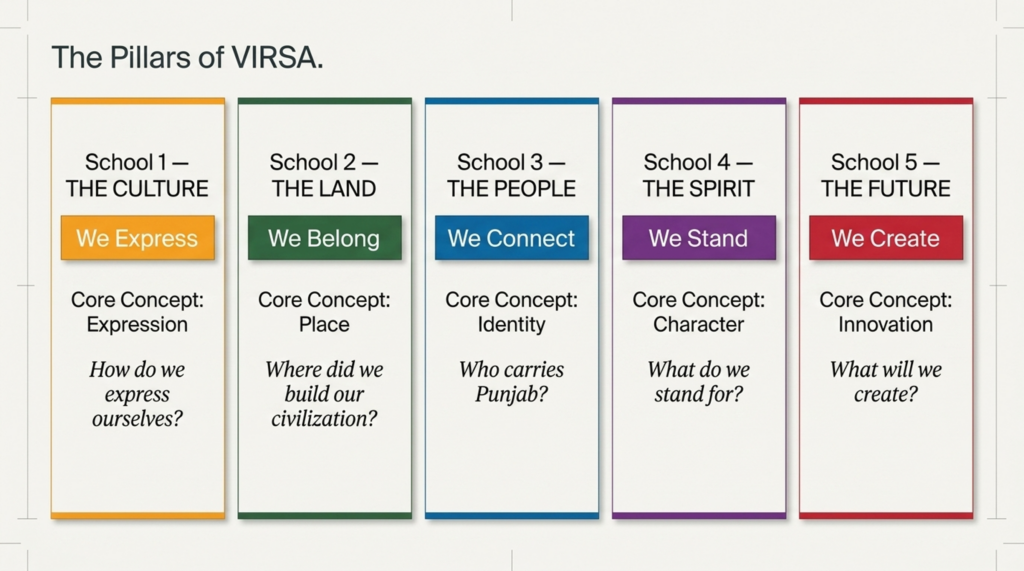
The five dimensions of VIRSA form the intellectual architecture of the program.
CULTURE | We Express
Language, literature, music, performance, traditions and cultural memory.
LAND | We Belong
Civilization, geography, agriculture, water, ecology and heritage landscapes.
PEOPLE | We Connect
Migration, diaspora, genealogy, identity, oral history and community institutions.
SPIRIT | We Stand
Leadership, seva, social movements, ethics, justice and civic responsibility.
FUTURE | We Create
Digital humanities, AI, innovation, entrepreneurship and heritage technology.
HOW THE TWO-YEAR PROGRAM WORKS
YEAR 1 – LEARN
The first year builds the student’s academic foundation and specialist knowledge.
SEMESTER 1
VIRSA CORE
15 Credits | 5 Courses
Every student begins with the same interdisciplinary postgraduate foundation.
VC501: Understanding Punjab: Civilization, History & Heritage
Explore Punjab from ancient civilization through medieval and Sikh history, colonial transformation, Partition and the contemporary global Punjabi experience.
VC502: Punjabi Heritage: Language, Literature, Word, Voice & Spirit
Study Punjabi language, Gurmukhi, literature, oral traditions, music, cultural expression and selected dimensions of Gurbani and Sikh heritage as areas of scholarly inquiry.
VC503: Research Methods, Critical Thinking & Digital Humanities
Learn research design, archival research, oral history, academic writing, digital documentation, AI-assisted research, OCR, NLP and digital humanities.
VC504: Sustainability, Ethics & Responsible Citizenship
Examine Punjab’s land, water, environment, sustainability challenges, ethical responsibilities and community stewardship.
VC505: Innovation, Design Thinking & Creative Problem Solving
Transform problems into ideas through creativity, design thinking, prototyping, entrepreneurship and innovation.
SEMESTER 2
CHOOSE YOUR SPECIALIZATION
15 Credits | 5 Courses
After completing the VIRSA Core, students select one of five Schools.
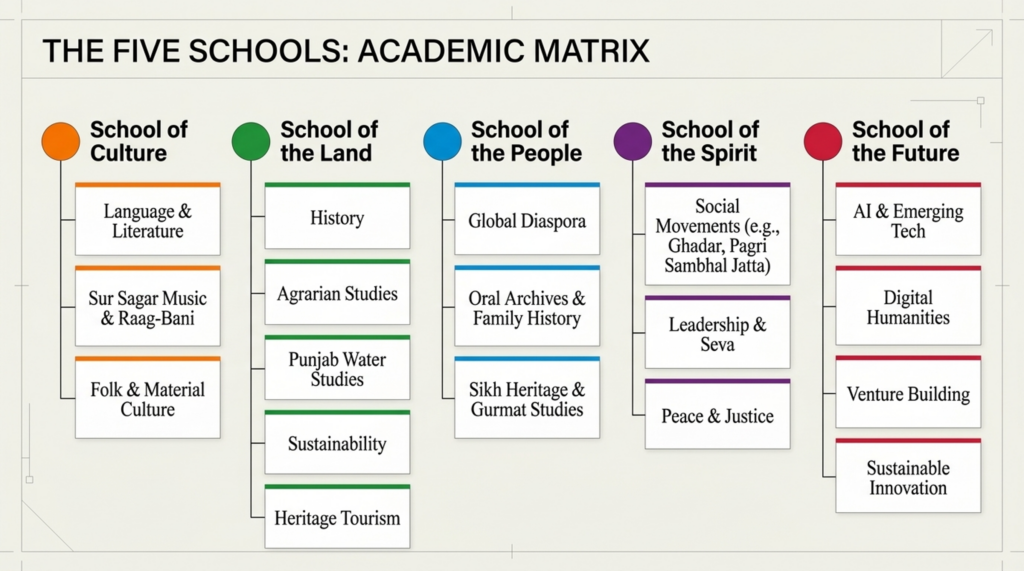
SCHOOL OF CULTURE
Punjabi Culture, Literature & Performing Arts
WE EXPRESS
For students interested in Punjabi language, literature, music, performance and cultural preservation.
Courses
CU501 – Advanced Punjabi Literature & Literary Criticism
CU502 – Gurmukhi, Punjabi Linguistics & Translation
CU503 – Punjabi Music, Raag–Bani & Performance Studies
CU504 – Folk, Material Culture & Heritage Preservation
CU505 – Cultural Research & Creative Practice
Possible Career Directions
- Cultural researcher
- Punjabi literature specialist
- Language educator
- Performing arts professional
- Cultural archivist
- Literary researcher
- Creative practitioner
- Cultural program manager
SCHOOL OF LAND
Punjab Civilization, Land & Sustainability
WE BELONG
For students interested in Punjab’s civilization, agriculture, water, environment and heritage landscapes.
Courses
LA501 – Advanced Punjab History & Civilization
LA502 – Agrarian Punjab, Land Systems & Rural Economy
LA503 – Punjab Water, Rivers & Water Governance
LA504 – Sustainability, Climate & Ecology of Punjab
LA505 – Heritage Tourism, Rural & Urban Heritage
Possible Career Directions
- Heritage researcher
- Sustainability professional
- Heritage tourism specialist
- Rural development professional
- Environmental researcher
- Cultural landscape specialist
- Community development professional
SCHOOL OF PEOPLE
Global Punjabi, Diaspora & Community Studies
WE CONNECT
For students interested in migration, diaspora, identity, genealogy, family history and global Punjabi communities.
Courses
PE501 – Global Punjabi Migration & Diaspora Studies
PE502 – Family History, Genealogy & Partition Memory
PE503 – Oral History, Archives & Digital Documentation
PE504 – Sikh Heritage, Gurmat & Community Institutions
PE505 – Punjabi Education, Identity & Community Development
Possible Career Directions
- Oral historian
- Genealogy researcher
- Diaspora researcher
- Community program manager
- Cultural educator
- Archivist
- Heritage consultant
- Community development professional
SCHOOL OF SPIRIT
Punjabi Struggles, Leadership & Seva
WE STAND
For students interested in leadership, social movements, ethics, justice, service and civic responsibility.
Courses
ST501 – Punjabi Social Movements & Historical Struggles
ST502 – Leadership, Ethics & Seva
ST503 – Peace, Justice & Reconciliation
ST504 – Civic & Community Leadership
ST505 – Social Research, Advocacy & Community Impact
Possible Career Directions
- Community leader
- Social-impact professional
- Researcher
- Civic program manager
- Nonprofit professional
- Advocacy researcher
- Community development specialist
- Social entrepreneur
SCHOOL OF FUTURE
Digital Heritage, AI & Cultural Innovation
WE CREATE
For students who want to combine Punjabi heritage with technology, artificial intelligence, entrepreneurship and innovation.
Courses
FU501 – Digital Humanities & Heritage Technologies
FU502 – AI, NLP, OCR & Punjabi Language Technology
FU503 – Digital Archives, Mapping & Knowledge Graphs
FU504 – Cultural Innovation, Entrepreneurship & Venture Building
FU505 – Sustainable Innovation & Heritage Technology
Possible Career Directions
- Digital humanities specialist
- Heritage technology professional
- AI / NLP researcher
- Digital archivist
- Cultural technologist
- Heritage entrepreneur
- Digital product developer
- Social-impact innovator
YEAR 2
EARN WHILE LEARN
60 Academic Credits
Year 2 is where VIRSA becomes fundamentally different from a conventional postgraduate classroom program.
Students take their knowledge into the real world.
They work.
They research.
They create.
They solve problems.
They build professional experience.
And they produce measurable outcomes.
WHAT DOES “EARN WHILE LEARN” MEAN?
Students may complete their Year 2 experience through one of three approved pathways.
01 – PAID EMPLOYMENT / APPRENTICESHIP
Work with an approved organization in a role connected to the student’s specialization.
02 – RESEARCH / INSTITUTIONAL PLACEMENT
Work with VIRSA, a research center, archive, university, museum, cultural organization, community institution or approved partner.
03 – VENTURE / SELF-EMPLOYMENT
Develop an approved cultural enterprise, technology venture, social enterprise, educational initiative or heritage project.
YEAR 2 COURSES
EWL501
Work-Integrated Learning I: Professional Practice & Applied Research
15 Credits
Students enter an approved professional, research, cultural, educational, community or entrepreneurial environment.
Students establish:
- Learning objectives
- Professional work plan
- Placement agreement
- Workplace mentor
- Academic supervisor
- Progress reports
- Reflective journal
- Professional portfolio
EWL502
Research, Innovation & Field Project I
15 Credits
Students identify a real-world problem and develop an applied project.
The Project Journey
Research Problem -> Investigation -> Design -> Prototype / Output -> Evaluation
Students might:
- Create an oral-history archive.
- Digitize historical materials.
- Map a heritage site.
- Research Punjab’s water challenges.
- Develop Punjabi educational resources.
- Document a disappearing musical tradition.
- Develop a genealogy platform.
- Build a cultural enterprise.
- Create a Punjabi AI prototype.
EWL503
Work-Integrated Learning II: Advanced Practice & Impact
15 Credits
Students take greater responsibility within their placement, research project or venture.
The emphasis moves from participation to professional competence and measurable impact.
Students demonstrate:
- Professional judgment
- Research capability
- Leadership
- Innovation
- Problem-solving
- Ethical practice
- Communication
- Project management
- Impact
EWL504
VIRSA Capstone: Professional Portfolio, Enterprise & Community Impact
15 Credits
The Capstone is the culmination of the entire two-year journey.
KNOWLEDGE + RESEARCH + CREATION + IMPACT
Students produce a substantial final project that demonstrates their ability to transform postgraduate learning into a meaningful outcome.
CAPSTONE EXAMPLES
CULTURE
A critical literary study, music archive, performance, cultural documentation project or creative work.
LAND
A Punjab water research project, sustainability intervention, heritage landscape study or tourism strategy.
PEOPLE
An oral-history archive, genealogy project, diaspora study or community research project.
SPIRIT
A social-movement study, leadership project, seva initiative or community-impact program.
FUTURE
A Punjabi AI application, digital archive, knowledge platform, heritage technology or cultural startup.
YOUR CAPSTONE DELIVERABLES
Every student completes:
- Research or professional report
- Practical / creative output
- Prototype, archive, performance, product or enterprise plan
- Academic presentation
- Viva / defense
- Professional portfolio
- Reflection report
- Impact assessment
LEARNING BY DOING
At VIRSA, academic credit is based on demonstrated learning.
Students are assessed through:
Knowledge
Can you understand and explain?
Research
Can you investigate and evaluate?
Application
Can you apply knowledge to a real problem?
Creation
Can you produce something meaningful?
Impact
Can you demonstrate value?
ASSESSMENT
YEAR 1
| Component | Weight |
| Knowledge & conceptual understanding | 30% |
| Research & analysis | 20% |
| Applied project | 20% |
| Presentation / performance | 15% |
| Portfolio / reflection | 15% |
YEAR 2
| Component | Weight |
| Workplace / supervisor evaluation | 25% |
| Applied research / professional output | 25% |
| Project quality & innovation | 20% |
| Portfolio & documentation | 15% |
| Viva / presentation / reflection | 15% |
RESEARCH AT VIRSA
Research is at the heart of the program.
Students learn to work with:
- Historical documents
- Archives
- Oral histories
- Interviews
- Family records
- Genealogical sources
- Literature
- Music
- Maps
- Photographs
- Digital collections
- Community knowledge
- Contemporary datasets
Students are expected to distinguish between:
Historical Evidence
Oral Tradition
Community Memory
Theological Interpretation
Academic Interpretation
Contemporary Opinion
This distinction is fundamental to responsible heritage scholarship.
DIGITAL PUNJABI HERITAGE
The future of heritage is digital.
VIRSA integrates emerging technologies into heritage scholarship, including:
Artificial Intelligence: Responsible use of AI for research, analysis, preservation and cultural innovation.
OCR: Digitization and recognition of historical Punjabi documents.
NLP: Natural-language processing for Punjabi language research and technology.
Digital Archives: Creating searchable collections of manuscripts, photographs, recordings and documents.
Mapping: Geographic visualization of historical places, migration and cultural landscapes.
Knowledge Graphs: Connecting people, places, events, texts and cultural relationships.
Digital Storytelling: Bringing Punjabi heritage to global audiences through multimedia.
GLOBAL PUNJABI HERITAGE
Punjabi heritage is global.
The program recognizes Punjabi communities across:
- India
- Pakistan
- United Kingdom
- United States
- Canada
- Australia
- New Zealand
- Europe
- East Africa
- Middle East
- Southeast Asia
- Other global communities
Students can investigate how migration has transformed language, identity, culture, institutions and community life.
WHO IS THIS PROGRAM FOR?
The program is designed for graduates who want to deepen their academic and professional engagement with Punjabi heritage.
It may be particularly relevant to graduates in:
- Humanities
- Social sciences
- Punjabi
- History
- Heritage studies
- Literature
- Music
- Performing arts
- Education
- Environmental studies
- Technology
- Digital humanities
- Business
- Entrepreneurship
- Communications
You do not have to come from a Punjabi academic background.
The program is intentionally multidisciplinary.
ADMISSION
Proposed Eligibility
A bachelor’s degree or equivalent qualification from a recognized institution, subject to the admission requirements of the awarding university.
Applicants may be considered from diverse academic disciplines.
The ideal candidate is someone who wants to:
- Understand Punjabi heritage deeply.
- Conduct meaningful research.
- Preserve cultural knowledge.
- Work with communities.
- Develop professional skills.
- Use technology responsibly.
- Build new cultural initiatives.
- Create measurable impact.
WHAT WILL YOU BECOME?
The program is designed to develop a new generation of Global Punjabi Heritage Professionals.
Graduates may pursue careers in:
EDUCATION
Punjabi education, curriculum, teaching resources and educational innovation.
RESEARCH
Universities, research institutes, archives and heritage organizations.
CULTURE
Museums, cultural institutions, music, literature and performing arts.
COMMUNITY
Nonprofits, community institutions, diaspora organizations and development programs.
DIGITAL HERITAGE
Digital archives, AI, NLP, mapping, knowledge systems and digital humanities.
HERITAGE TOURISM
Cultural tourism, heritage interpretation and destination development.
ENTREPRENEURSHIP
Cultural enterprises, technology ventures, social enterprises and creative businesses.
PUBLIC SERVICE
Community development, civic initiatives and cultural policy.
THE VIRSA GRADUATE
A VIRSA graduate is expected to become more than a subject-matter specialist.
The goal is to develop a:
SCHOLAR
Who understands evidence and scholarship.
RESEARCHER
Who can ask meaningful questions and investigate them rigorously.
PRACTITIONER
Who can apply knowledge in professional environments.
CREATOR
Who can produce meaningful cultural and intellectual outputs.
INNOVATOR
Who can use technology and entrepreneurship responsibly.
COMMUNITY LEADER
Who understands service, ethics and social responsibility.
A PROGRAM BUILT AROUND IMPACT
The VIRSA model can be summarized in six words:
LEARN
Build knowledge.
RESEARCH
Discover evidence.
CONNECT
Engage communities.
CREATE
Build something meaningful.
INNOVATE
Prepare heritage for the future.
IMPACT
Return value to society.
WHY A TWO-YEAR MODEL?
A conventional postgraduate classroom program can provide knowledge.
VIRSA goes further.
YEAR 1
Students build the intellectual foundation.
YEAR 2
Students demonstrate what they can do with that knowledge.
This creates a progression from:
Knowledge → Research → Practice → Creation → Impact
The second year is therefore not an extension of classroom instruction.
It is the bridge between academic learning and professional life.
THE 90-CREDIT JOURNEY
15 Credits | VIRSA CORE | Understand the civilization.
↓
15 Credits | SPECIALIZATION | Choose your field.
↓
30 Credits | EARN WHILE LEARN I Apply your knowledge.
↓
30 Credits | EARN WHILE LEARN II | Create measurable impact.
↓
90 CREDITS | GLOBAL PUNJABI HERITAGE PROFESSIONAL
ACADEMIC QUALITY
VIRSA’s postgraduate model emphasizes:
- Academic governance
- Qualified faculty
- Research ethics
- External academic review
- Academic integrity
- Responsible AI use
- Formal EWL supervision
- Workplace mentorship
- Documented learning outcomes
- Portfolio assessment
- Capstone evaluation
YOUR FUTURE CAN BEGIN WITH HERITAGE
The world does not need heritage that simply sits in archives.
It needs people who can:
Understand it.
Preserve it.
Research it.
Digitize it.
Teach it.
Build with it.
And carry it into the future.
That is the purpose of VIRSA.
APPLY TO VIRSA
Post Graduate Certificate in Global Punjabi Heritage Studies
Two Years | 90 Credits | Five Schools | Earn While Learn
Choose your path.
Culture: We Express.
Land: We Belong.
People: We Connect.
Spirit: We Stand.
Future: We Create.
BEGIN YOUR VIRSA JOURNEY
Your heritage is not only something to remember.
It is something to understand, research, preserve and create for the future.
Join VIRSA.
Learn the heritage.
Research the heritage.
Serve the heritage.
Create the future.
VIRSA – Global Punjabi Heritage Institute
Culture • Land • People • Spirit • Future