NEXUS–SEMICON | THE SEMICONDUCTOR CAREER CODE
WEEK 6 → BUILD YOUR NETWORK
Prof. Baljit Singh | bsingh@gndgu.com
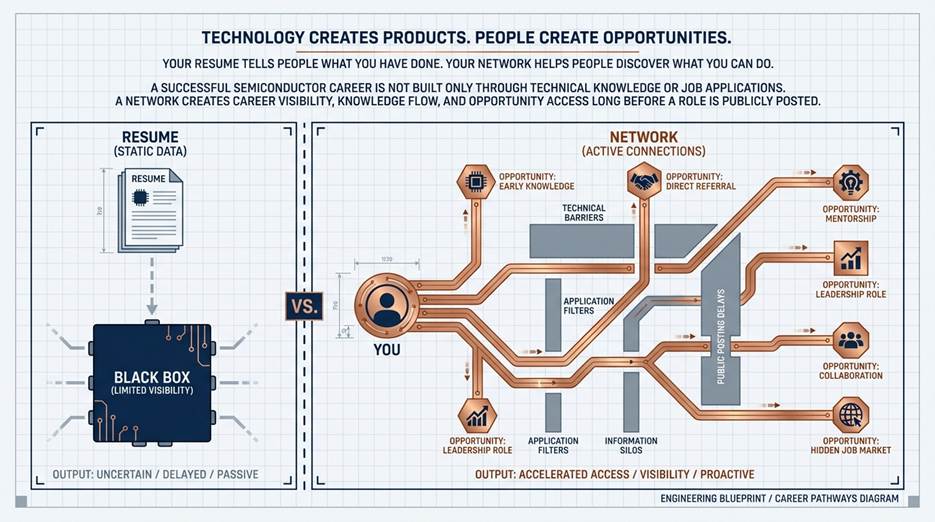
A successful semiconductor career is not built only through technical knowledge, degrees, certifications, or job applications. It is also built through relationships.
Your network can help you discover opportunities before they are publicly posted, understand different career paths, learn from experienced professionals, find mentors, and become visible within the industry.
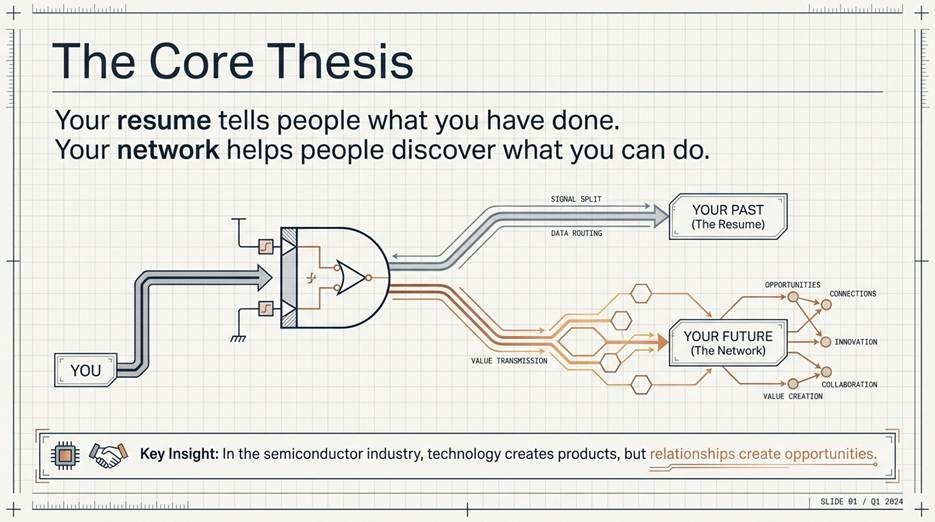
But networking is not simply about collecting LinkedIn connections.
Real networking is about building meaningful professional relationships over time.
1. What Is Professional Networking?
Professional networking is the process of developing and maintaining relationships with people who share your professional interests, industry, career goals, or areas of expertise.
In the semiconductor industry, your network can include:
- Classmates and alumni
- Professors and researchers
- Semiconductor engineers
- Engineering managers
- Technical leaders
- Recruiters
- Hiring managers
- Executives
- Consultants
- Entrepreneurs
- Industry association members
- Conference speakers
- Suppliers and technology partners
- Former colleagues
Your objective should not be:
“How many people can I connect with?”
Instead, ask:
“How many meaningful professional relationships can I build?”
2. Why Networking Matters in Semiconductors
The semiconductor industry is highly specialized.
Opportunities often emerge through relationships between people working across:
Design → Verification → Fabrication → Packaging → Testing → Equipment → Materials → Manufacturing → Supply Chain → Applications → Business
Someone you meet today may become:
- Your mentor tomorrow
- Your colleague next year
- Your hiring manager later
- Your customer in the future
- Your business partner
- Your introduction to another industry leader
A network creates career visibility, knowledge flow, and opportunity access.
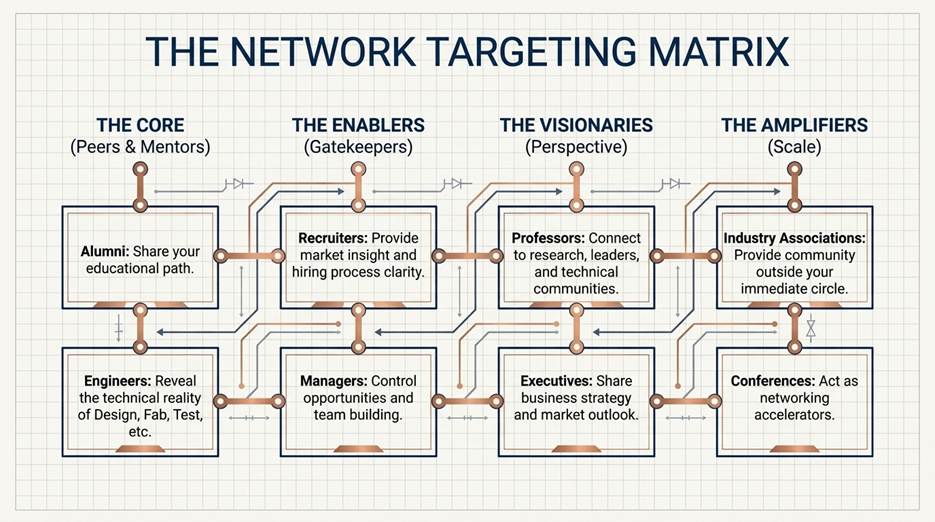
3. The Eight Networking Groups You Should Build
Your 50-person network should not consist of 50 recruiters.
Build a balanced network.
3.1 Alumni
Connect with graduates from your university or program who are working in semiconductor companies.
Ask:
- What path did you take?
- What skills helped you most?
- What would you recommend I learn?
- What does your company look for in candidates?
Alumni often have a natural connection to you because you share an educational background.
3.2 Professors
Professors can provide much more than academic instruction.
They may know:
- Researchers
- Industry leaders
- Former students
- Semiconductor companies
- Research opportunities
- Conferences
- Internships
- Technical communities
Maintain relationships with professors even after graduation.
3.3 Engineers
Engineers are the people closest to the technology.
Connect with professionals working in areas such as:
- IC Design
- Analog
- Digital
- RF
- Verification
- Physical Design
- EDA
- Process Engineering
- Yield Engineering
- Equipment Engineering
- Packaging
- Test
- Reliability
- Manufacturing
- Semiconductor Materials
Learn how their work actually happens.
3.4 Recruiters
Recruiters can provide valuable insight into:
- Open positions
- Required skills
- Resume expectations
- Hiring processes
- Geographic opportunities
- Industry demand
But don’t contact recruiters only when you need a job.
Build the relationship before you need it.
3.5 Executives
Executives can provide a broader perspective.
Learn how they think about:
- Technology
- Markets
- Customers
- Leadership
- Innovation
- Manufacturing
- Talent
- Business strategy
Don’t approach executives simply by asking for a job.
Approach them with curiosity and respect.
3.6 Industry Associations
Professional associations can dramatically expand your network.
Look for organizations connected to:
- Semiconductors
- Electronics
- Microelectronics
- Manufacturing
- Materials
- Packaging
- Test
- Engineering
- Technology leadership
Associations provide opportunities to meet people outside your immediate university or company.
3.7 Conferences
Conferences are networking accelerators.
Before attending a conference:
- Research the speakers.
- Identify companies attending.
- Identify professionals you want to meet.
- Prepare questions.
- Introduce yourself.
- Follow up afterward.
A conference shouldn’t end when you leave the venue.
The follow-up is where networking becomes relationship building.
3.8 LinkedIn
LinkedIn can become your professional networking infrastructure.
Use it to:
- Find alumni
- Research companies
- Follow semiconductor leaders
- Engage with technical content
- Join professional communities
- Identify recruiters
- Discover conferences
- Share your work
- Maintain relationships
Don’t treat LinkedIn as a digital business-card collection.
Use it as a professional relationship platform.
4. The Networking Formula
Use this simple model:
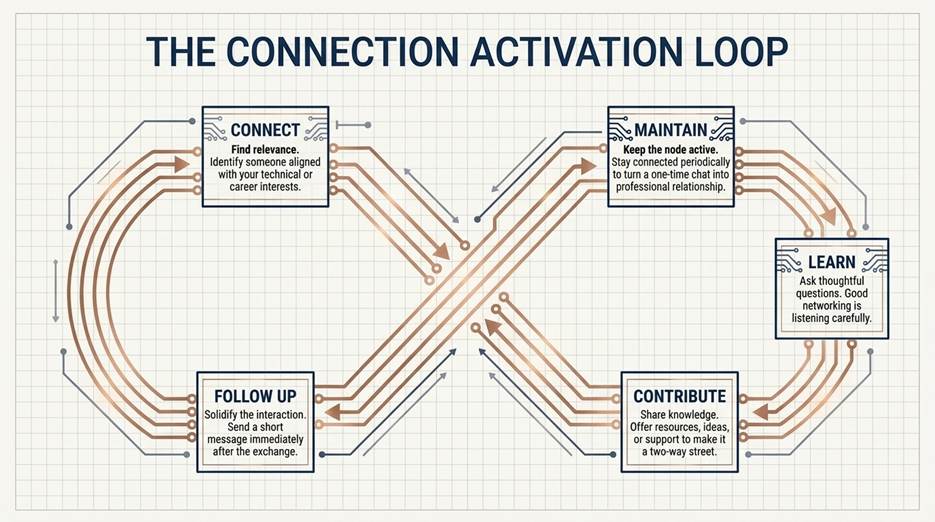
CONNECT → LEARN → CONTRIBUTE → FOLLOW UP → MAINTAIN
CONNECT
Find someone relevant to your career interests.
LEARN
Ask thoughtful questions.
CONTRIBUTE
Share knowledge, resources, ideas, or support.
FOLLOW UP
Send a short message after the interaction.
MAINTAIN
Stay connected periodically.
This turns a one-time interaction into a professional relationship.
5. How to Send a LinkedIn Connection Request
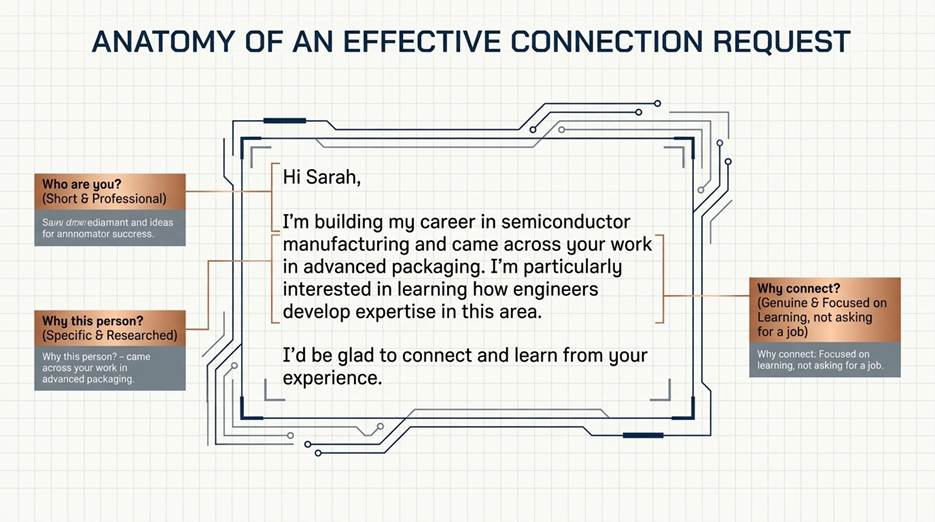
Avoid generic messages such as:
“Hi, please connect with me.”
Instead, explain why you’re interested in connecting.
Example
Hi Sarah, I’m building my career in semiconductor manufacturing and came across your work in advanced packaging. I’m particularly interested in learning how engineers develop expertise in this area. I’d be glad to connect and learn from your experience.
Keep it:
Short + Specific + Professional + Genuine
6. What Should You Talk About?
Networking conversations don’t have to be complicated.
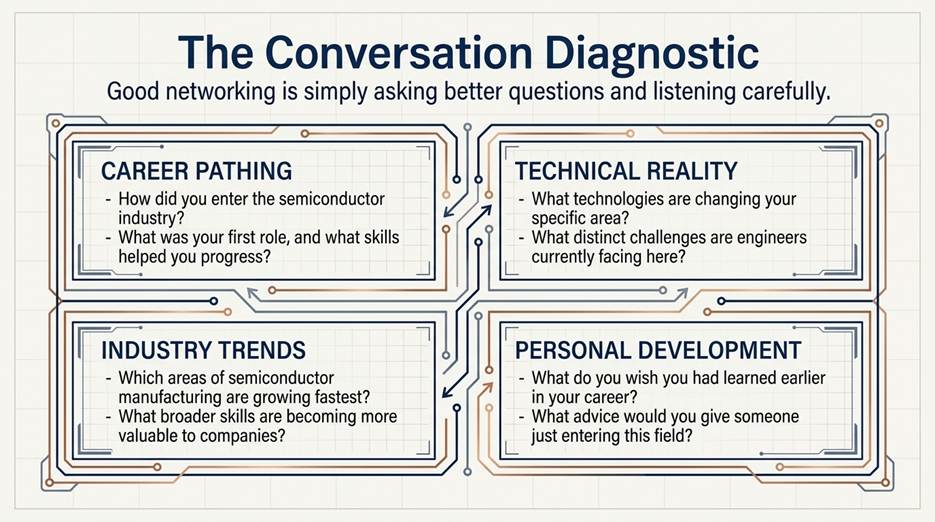
Ask questions such as:
Career
- How did you enter the semiconductor industry?
- What was your first semiconductor role?
- What skills helped you progress?
Technical
- What technologies are changing your area?
- What technical skills should early-career engineers develop?
- What challenges are engineers currently facing?
Industry
- What trends are changing semiconductor manufacturing?
- Which areas of the industry are growing?
- What skills are becoming more valuable?
Personal development
- What do you wish you had learned earlier?
- What advice would you give someone entering this field?
Good networking is often about asking better questions and listening carefully.
- Networking Mistakes to Avoid
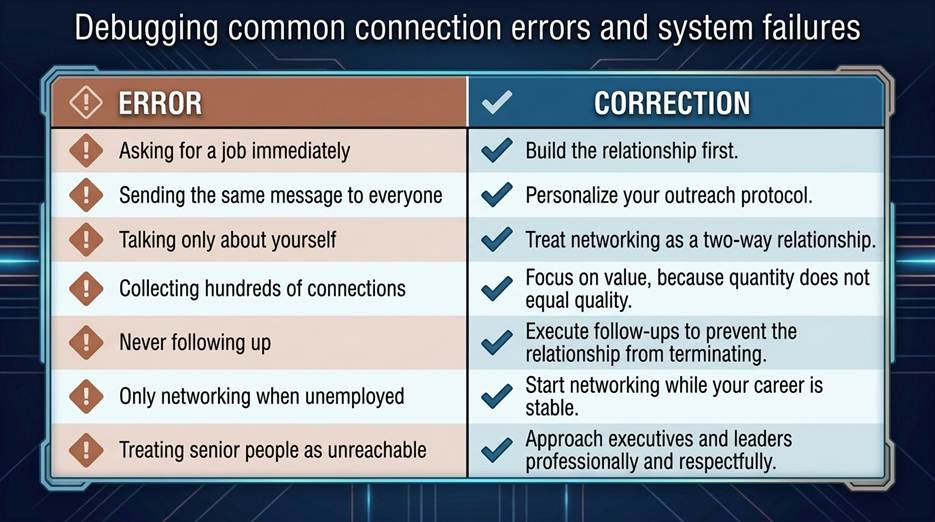
❌ Asking for a job immediately
Build the relationship first.
❌ Sending the same message to everyone
Personalize your outreach.
❌ Talking only about yourself
Networking is a two-way relationship.
❌ Collecting hundreds of connections
Quantity does not automatically create value.
❌ Never following up
A missed follow-up can end a promising relationship.
❌ Only networking when unemployed
Start networking while you’re doing well.
❌ Treating senior people as unreachable
Executives, professors, engineers, and technical leaders are people too.
Approach them professionally and respectfully.
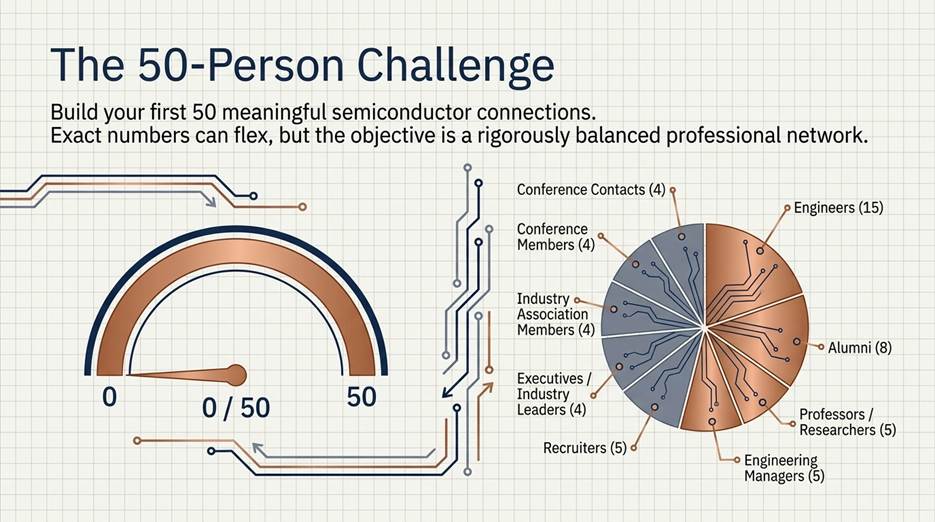
8. Your 50-Person Semiconductor Network
This week’s challenge is simple:
BUILD YOUR FIRST 50
Create a spreadsheet or document with 50 relevant semiconductor professionals.
A suggested structure:
| Category | Target |
| Alumni | 8 |
| Professors/Researchers | 5 |
| Engineers | 15 |
| Engineering Managers | 5 |
| Recruiters | 5 |
| Executives/Industry Leaders | 4 |
| Industry Association Members | 4 |
| Conference/Semiconductor Contacts | 4 |
| TOTAL | 50 |
The categories don’t have to match these exact numbers.
The objective is to create a balanced professional network.
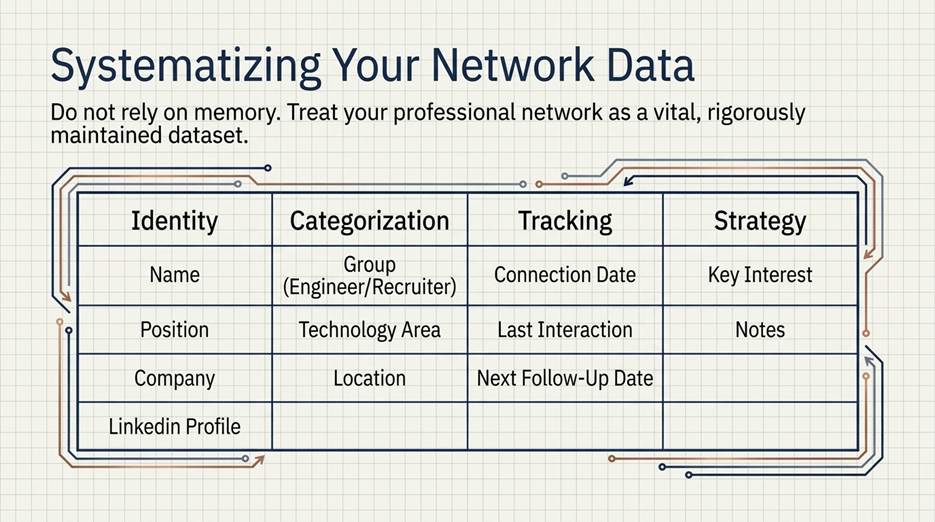
9. Your Network Database
Create these columns:
| Field | Information |
| Name | Person’s name |
| Position | Current role |
| Company | Organization |
| Category | Engineer / Alumni / Recruiter etc. |
| Technology Area | Design / Fab / Packaging / Test etc. |
| Location | City/Region |
| Profile | |
| How You Found Them | Alumni / Conference / LinkedIn etc. |
| Connection Date | Date contacted |
| Last Interaction | Most recent contact |
| Key Interest | What you want to learn |
| Follow-Up Date | Next contact |
| Notes | Important details |
This becomes your Personal Semiconductor Network Database.
10. The 50-Person Rule
Don’t try to contact all 50 people in one day.
Use a simple weekly rhythm:
Research → Connect → Communicate → Follow Up → Maintain
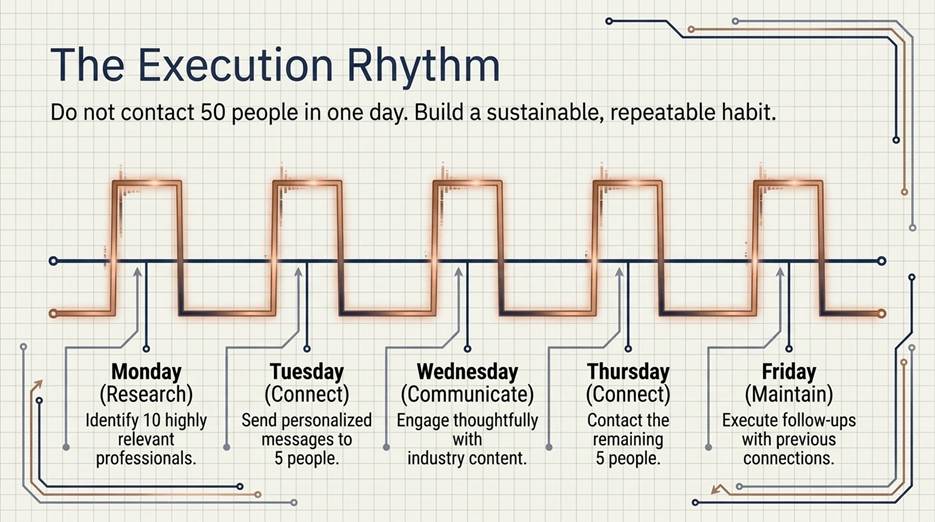
For example:
Monday: Research 10 people
Tuesday: Contact 5 people
Wednesday: Engage with industry content
Thursday: Contact 5 more people
Friday: Follow up with previous connections
The goal is to build a repeatable networking habit.
11. Your Networking Message
Your first message should answer three questions:
Who are you?
Why are you contacting this person?
Why would you like to connect?
Example:
Hello Mark, I’m developing my career in the semiconductor industry and came across your experience in semiconductor process engineering. Your career path caught my attention, and I’d appreciate the opportunity to connect and learn from your experience. Thank you.
Simple.
Professional.
Human.
12. Networking Is a Long-Term Investment
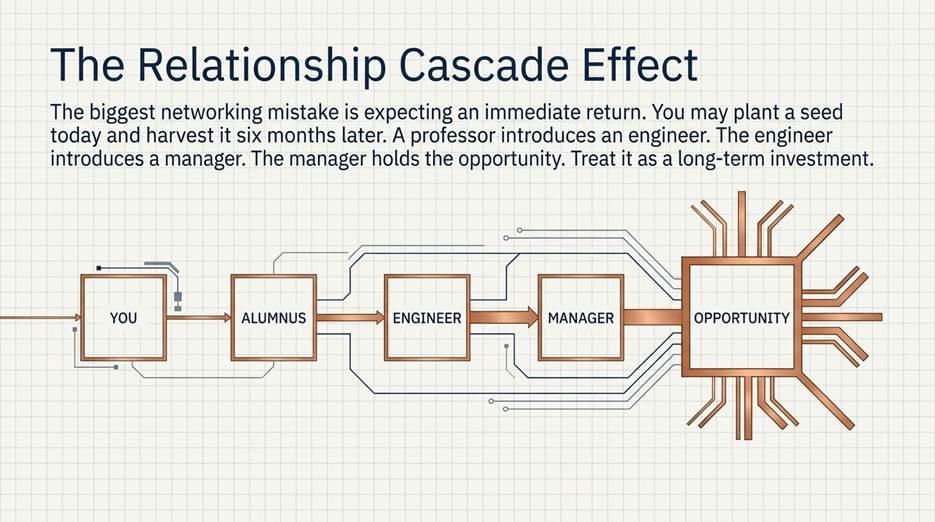
The biggest mistake is expecting an immediate return.
You may connect with someone today and hear from them six months later.
You may meet a professor who introduces you to an engineer.
That engineer may introduce you to a manager.
That manager may know about an opportunity.
The relationship chain can look like:
YOU → ALUMNUS → ENGINEER → MANAGER → OPPORTUNITY
That’s why networking matters.
WEEK 6 ACTIVITY
BUILD YOUR 50-PERSON SEMICONDUCTOR NETWORK
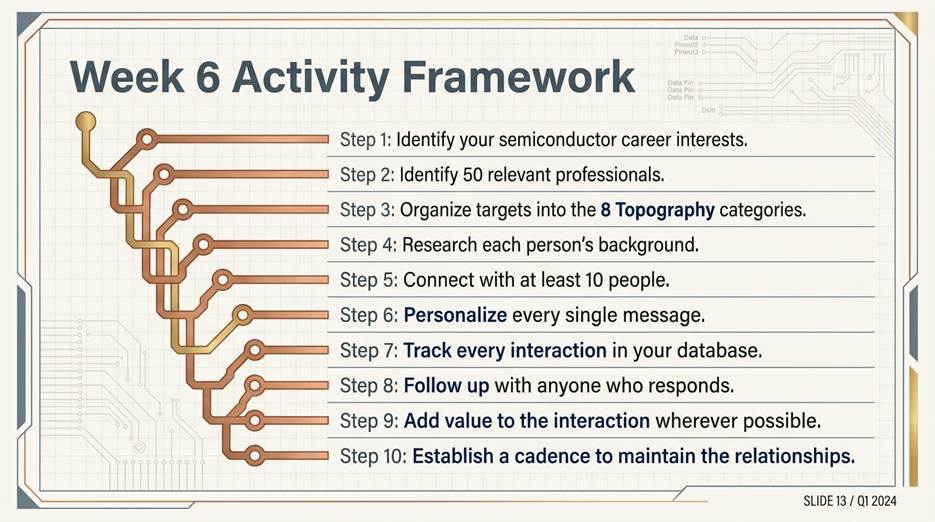
Step 1 – Identify your semiconductor career interests.
Step 2– Identify 50 relevant professionals.
Step 3 -Organize them into categories.
Step 4 – Research each person’s background.
Step 5 – Connect with at least 10 people.
Step 6 – Personalize every message.
Step 7 – Track every interaction.
Step 8 – Follow up with people who respond.
Step 9 – Add value wherever possible.
Step 10 – Continue maintaining the relationships.
WEEK 6 DELIVERABLE
MY 50-PERSON SEMICONDUCTOR NETWORK
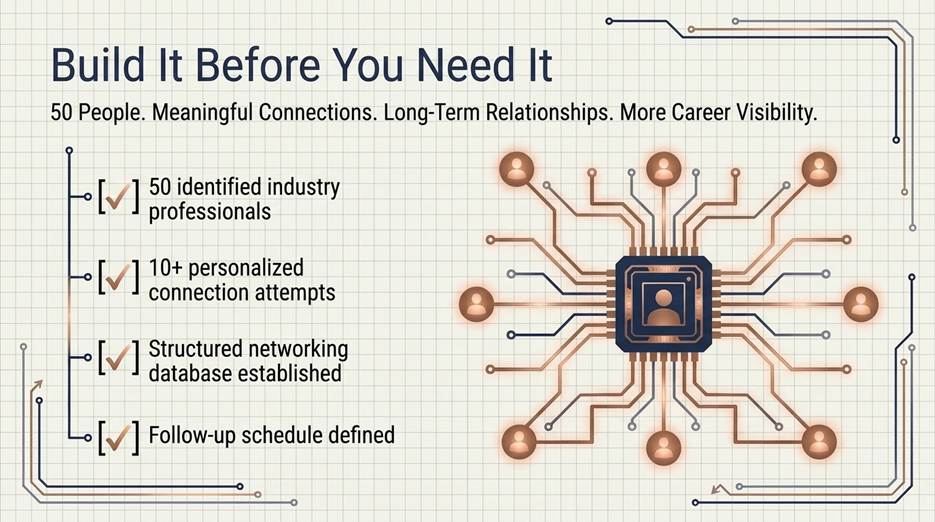
By the end of Week 6, you should have:
50 identified industry professionals
10+ personalized connection attempts
A structured networking database
A follow-up schedule
A clear understanding of your professional network
Most importantly, you should have started developing the habit of building relationships before you need them.
WEEK 6 KEY LESSON
Your resume tells people what you have done.
Your network helps people discover what you can do.
In the semiconductor industry, technology creates products—but people create opportunities.
NEXUS–SEMICON
THE SEMICONDUCTOR CAREER CODE
WEEK 6 → BUILD YOUR NETWORK
50 PEOPLE.
MEANINGFUL CONNECTIONS.
LONG-TERM RELATIONSHIPS.
MORE CAREER VISIBILITY.