NEXUS–SEMICON | THE SEMICONDUCTOR CAREER CODE
Baljit Singh | Email: bsingh@gndgu.com
Learn faster through people who have already traveled the road.
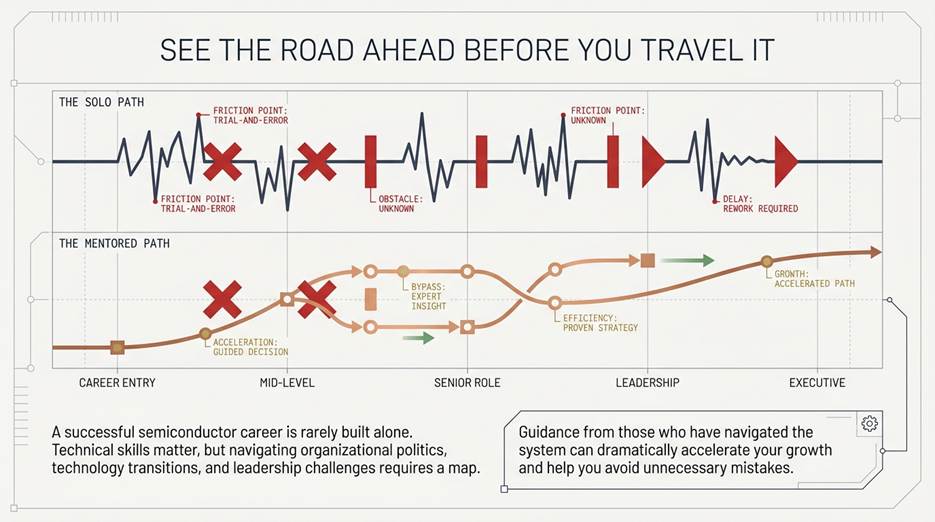
A successful semiconductor career is rarely built alone. Technical skills matter, but guidance from people who have already navigated engineering roles, promotions, organizational politics, technology transitions, and leadership challenges can dramatically accelerate your growth.
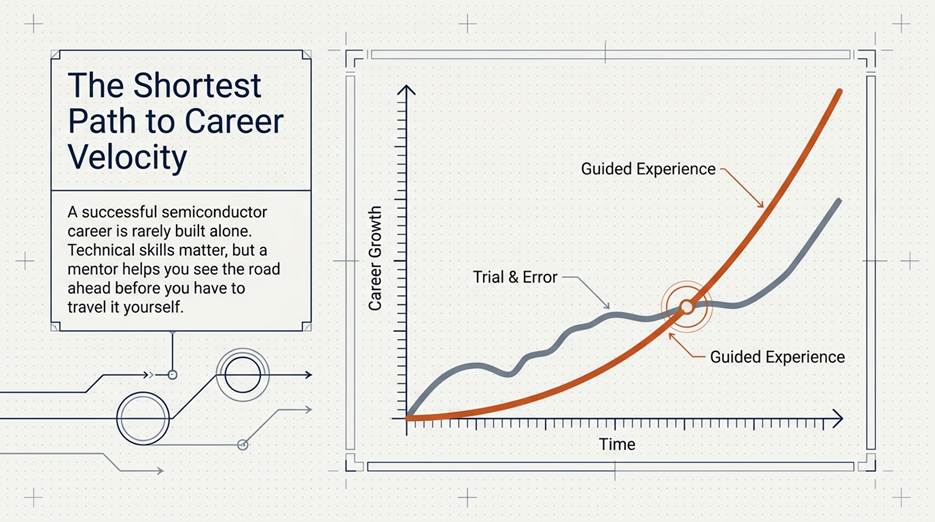
A mentor can help you see the road ahead before you have to travel it yourself.
🎯 WEEK 7 OBJECTIVE
By the end of Week 7, you should be able to:
- Understand the difference between a mentor, manager, and sponsor
- Identify professionals who could become valuable mentors
- Approach senior professionals appropriately
- Ask questions that generate meaningful career insight
- Build productive, long-term mentoring relationships
- Understand the value of reverse mentoring
- Create your own Career Advisory Circle
Your goal this week:
Identify 3 potential mentors and begin building relationships with them.
1. MENTOR vs. MANAGER vs. SPONSOR
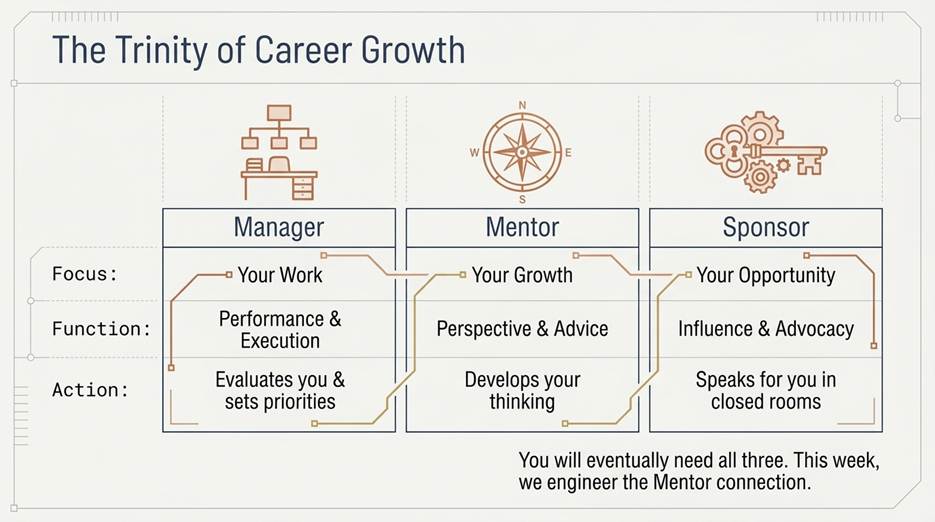
These three relationships are often confused, but they serve very different purposes.
👨🏫 Mentor
A mentor provides guidance, perspective, experience, and advice.
They may help you answer:
- What skills should I develop?
- What career path should I consider?
- How do I handle a difficult situation?
- What mistakes should I avoid?
- How can I prepare for my next role?
A mentor doesn’t necessarily work in your organization.
👔 Manager
A manager is responsible for your performance and execution.
They typically determine:
- Your responsibilities
- Your goals
- Your priorities
- Your performance evaluation
- Your project assignments
- Your development opportunities
Your manager manages your work.
A mentor helps develop you.
🚀 Sponsor
A sponsor actively uses their influence to create opportunities for you.
A sponsor may:
- Recommend you for a leadership role
- Put your name forward for an important project
- Introduce you to executives
- Advocate for your promotion
- Give you visibility
- Speak about your capabilities when you’re not in the room
Remember:
Manager → manages your performance
Mentor → develops your thinking
Sponsor → advocates for your opportunity
You may eventually need all three.
2. WHAT MAKES A GOOD MENTOR?
A mentor doesn’t have to be the most senior person you know.
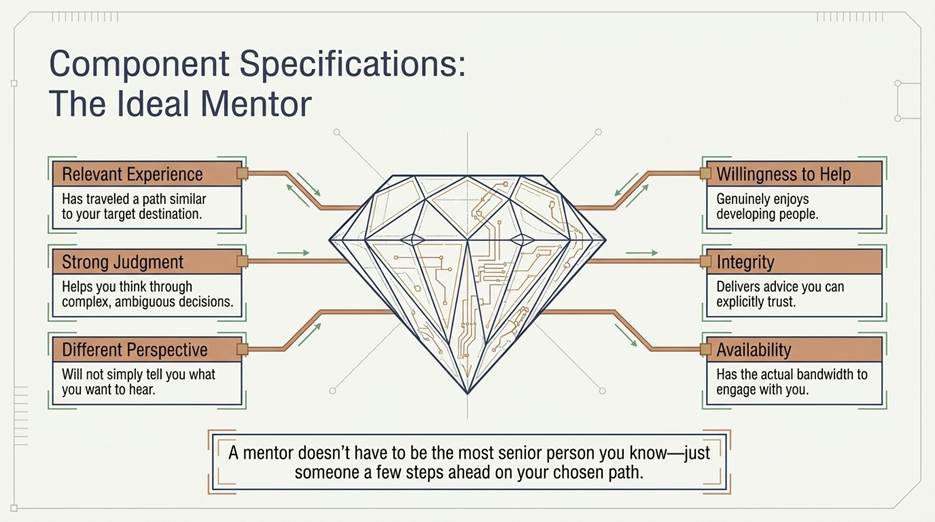
Look for someone who has:
1. Relevant experience: They have traveled a path similar to the one you want to pursue.
2. Strong judgment: They can help you think through complicated decisions.
3. Different perspective: They don’t simply tell you what you want to hear.
4. Willingness to help: They genuinely enjoy developing people.
5. Integrity: You can trust their advice.
6. Availability: Even an excellent potential mentor isn’t useful if they have no time to engage.
3. WHERE CAN YOU FIND MENTORS?
Don’t wait for someone to announce:
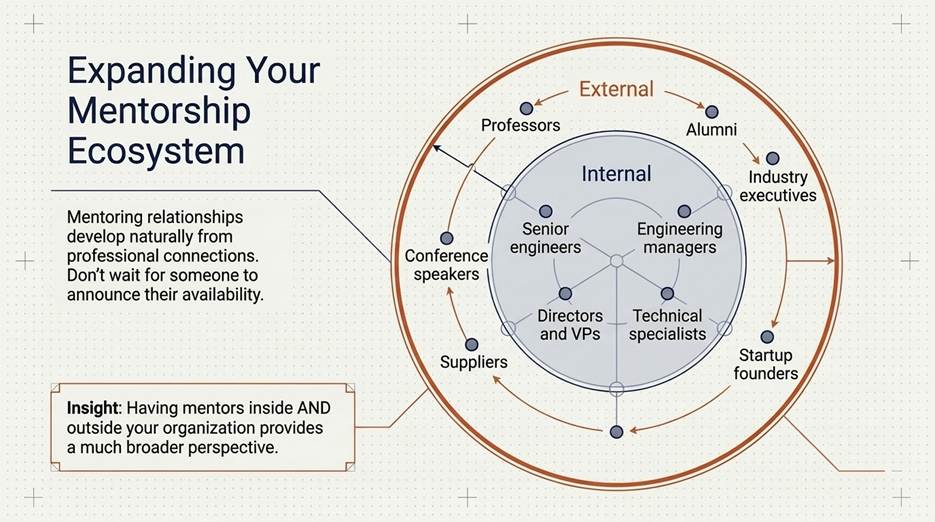
“I am available to be your mentor.”
Mentoring relationships often develop naturally from professional relationships.
Look across your network:
- Professors
- Former professors
- Alumni
- Senior engineers
- Staff and principal engineers
- Engineering managers
- Directors and VPs
- Former managers
- Technical specialists
- Industry executives
- Conference speakers
- Professional association leaders
- Former colleagues
- Customers
- Suppliers
- Startup founders
- Researchers
Your mentor does not necessarily need to be in your company.
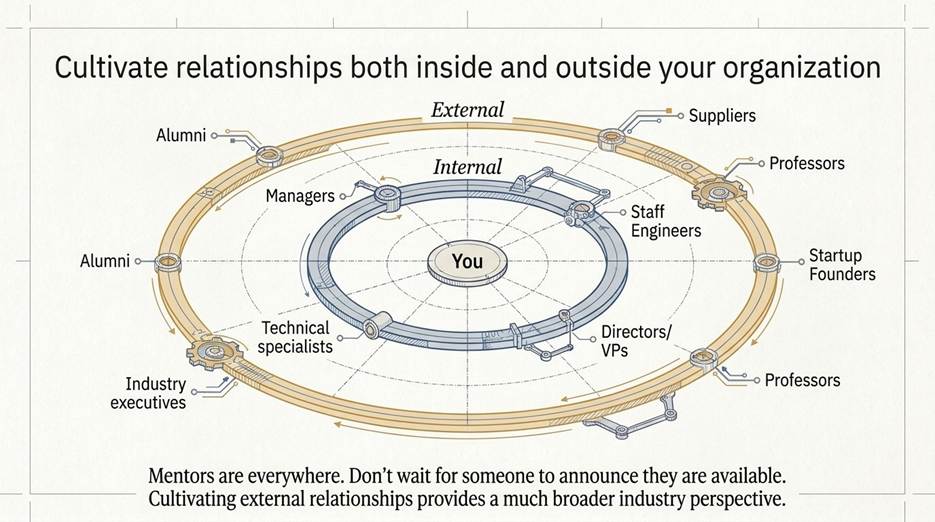
In fact, having mentors inside and outside your organization can provide a much broader perspective.
4. APPROACHING SENIOR PROFESSIONALS
One of the biggest mistakes early-career professionals make is sending:
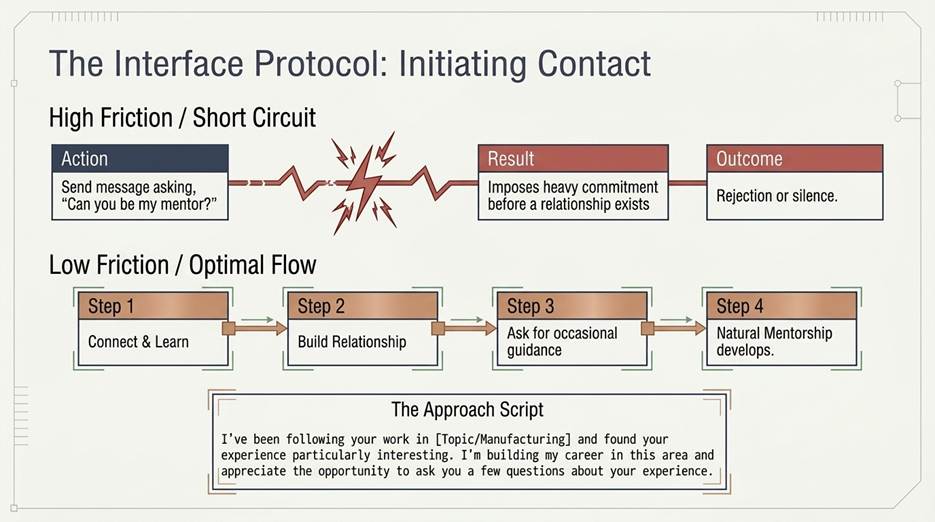
“Can you be my mentor?”
That can feel like a major commitment before a relationship exists.
Instead, start with something smaller.
Better approach:
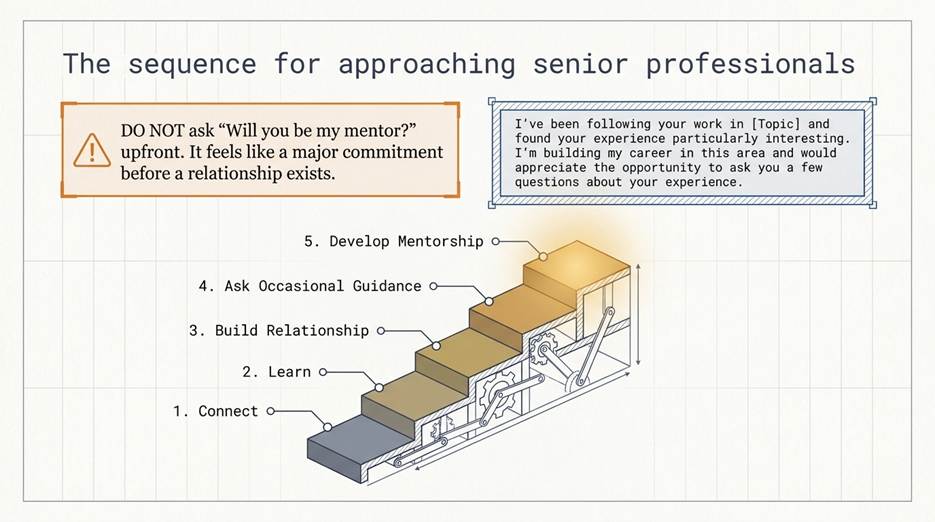
Connect → Learn → Build relationship → Ask for occasional guidance → Develop mentorship
For example:
“I’ve been following your work in semiconductor manufacturing and found your experience particularly interesting. I’m building my career in this area and would appreciate the opportunity to ask you a few questions about your experience.”
This is easier for someone to accept.
5. ASK BETTER QUESTIONS
The quality of your questions determines the quality of the advice you receive.
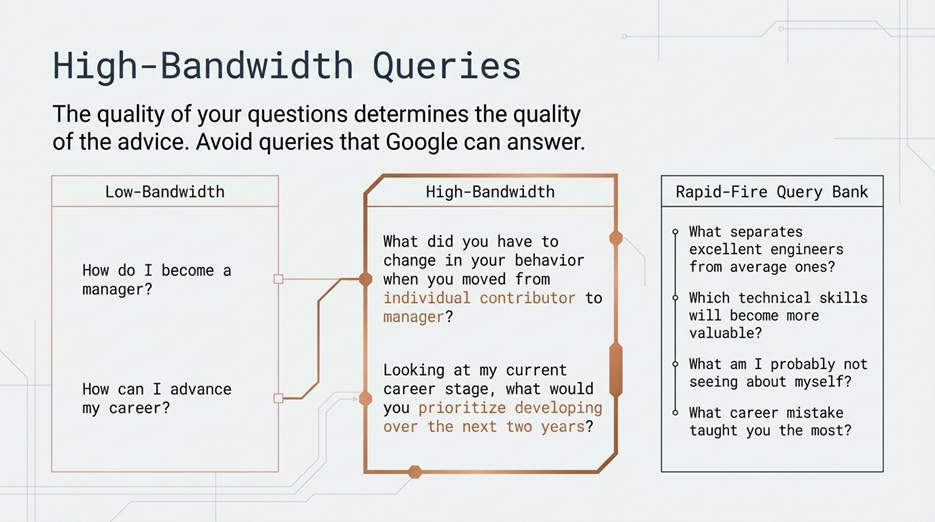
Avoid questions that can be answered with Google.
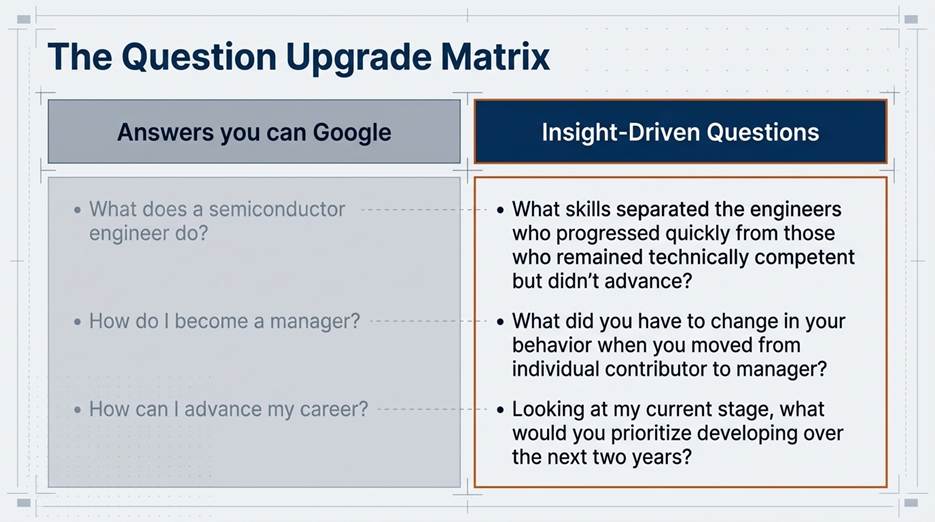
Instead of:
“What does a semiconductor engineer do?”
Ask:
“What skills separated the engineers who progressed quickly from those who remained technically competent but didn’t advance?”
Instead of:
“How do I become a manager?”
Ask:
“What did you have to change in your behavior when you moved from individual contributor to manager?”
Instead of:
“How can I advance my career?”
Ask:
“Looking at my current career stage, what would you prioritize developing over the next two years?”
Great mentor questions:
- What would you do differently if you were starting again?
- What career mistake taught you the most?
- Which technical skills will become more valuable?
- Which skills are often underestimated?
- What separates excellent engineers from average engineers?
- How did you build your professional network?
- When did you know it was time to change roles?
- How did you transition into leadership?
- What should I stop doing?
- What should I start doing?
- What am I probably not seeing about myself?
- Who else should I learn from?
6. MAKE THE RELATIONSHIP MUTUALLY VALUABLE
Mentoring should not become:
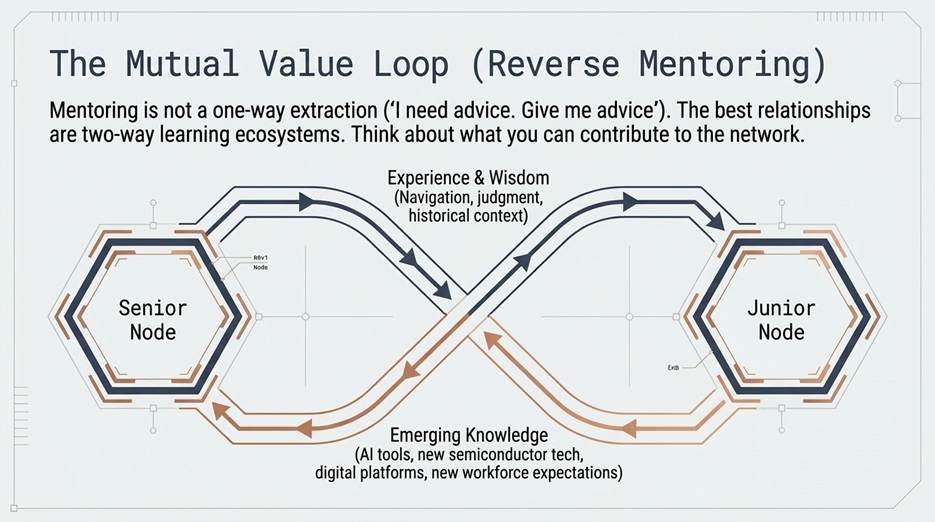
“I need advice. Give me advice.”
Think about what you can contribute.
You can:
- Share new technology trends
- Bring a younger-generation perspective
- Help with digital tools
- Share industry research
- Introduce them to people
- Help with research
- Provide feedback
- Share what you’re learning
- Offer technical knowledge
This leads to an important concept:
🔄 REVERSE MENTORING
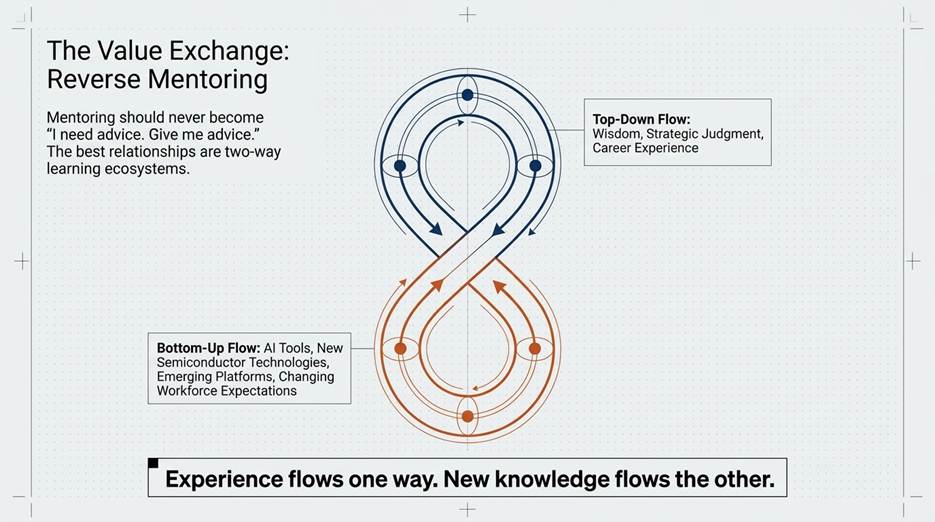
Mentoring doesn’t always flow from senior → junior.
A younger professional may understand:
- AI tools
- New semiconductor technologies
- Social media
- Emerging platforms
- New workforce expectations
- New customer behaviors
- New technical approaches
better than someone who has spent decades in the industry.
The best relationships can become two-way learning relationships.
Experience flows one way.
New knowledge flows the other way.
7. BUILD YOUR CAREER ADVISORY CIRCLE
One mentor is helpful.
A network of advisors is much more powerful.
Your Career Advisory Circle can include people with different strengths.
Suggested structure:
Technical Advisor: Someone who understands semiconductor technology deeply.
Career Advisor: Someone who understands career progression and professional development.
Leadership Advisor: Someone who has successfully moved into management or executive leadership.
Industry Advisor: Someone who understands the broader semiconductor ecosystem.
Entrepreneurship Advisor: Someone who understands startups, innovation, commercialization, or business development.
Personal Development Advisor: Someone who can challenge your thinking and help you become a better professional.
You don’t need six people immediately.
Start with three.
8. YOUR THREE-MENTOR STRATEGY
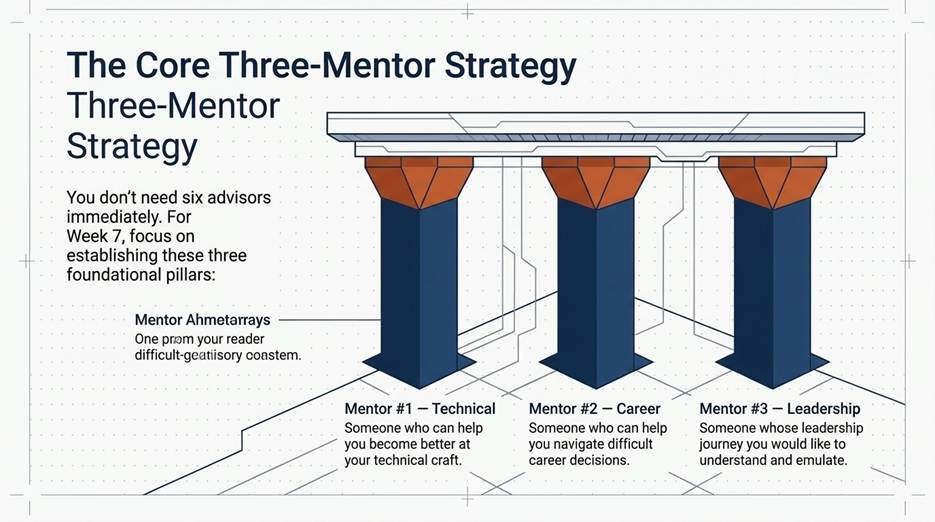
For this week, identify:
Mentor #1 – Technical
Someone who can help you become better at your technical craft.
Mentor #2 – Career
Someone who can help you navigate career decisions.
Mentor #3 – Leadership
Someone whose leadership journey you would like to understand and eventually emulate.
These three perspectives can give you a much more complete view of your career.
9. THE 30-MINUTE MENTOR MEETING
Don’t make mentoring complicated.
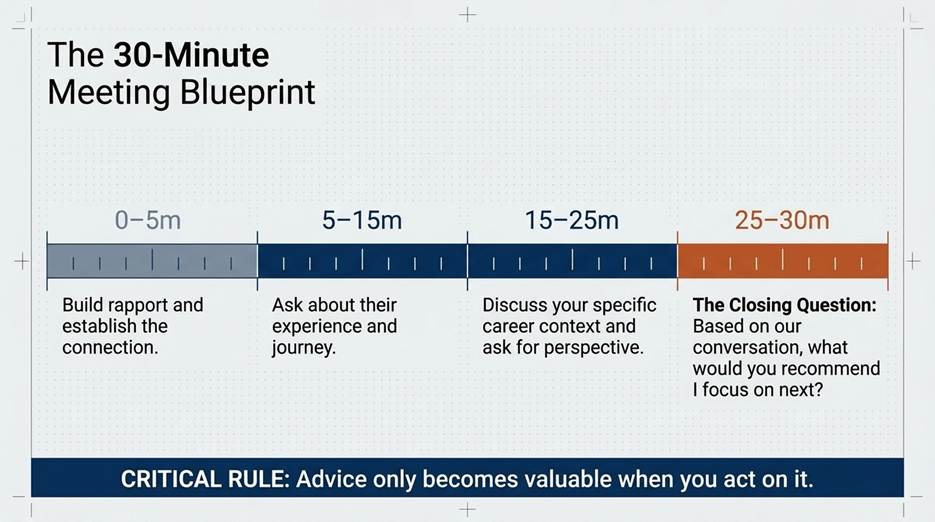
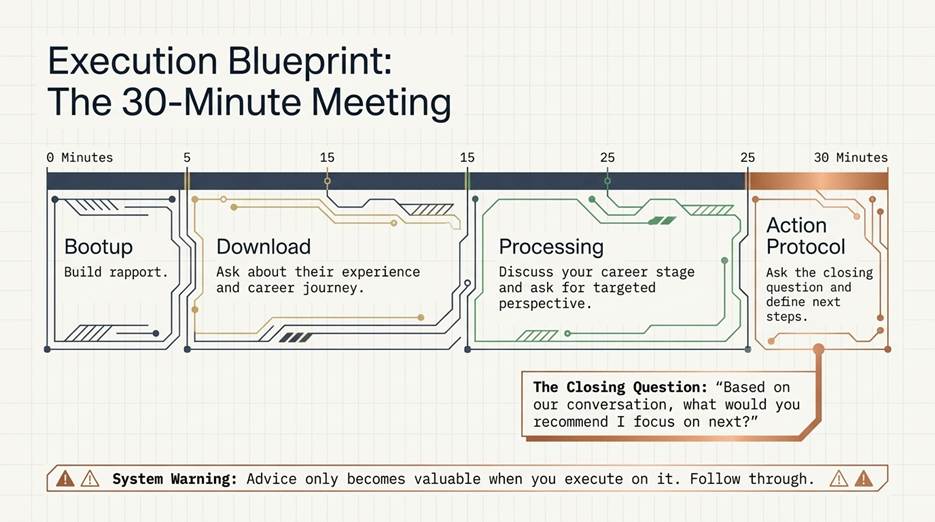
A simple 30-minute conversation can be extremely valuable.
First 5 minutes
Build rapport.
Next 10 minutes
Ask about their experience.
Next 10 minutes
Discuss your career and ask for perspective.
Final 5 minutes
Ask:
“Based on our conversation, what would you recommend I focus on next?”
Then follow through.
The most important rule:
Advice only becomes valuable when you act on it.
10. KEEP A MENTOR JOURNAL
After every meaningful conversation, record:
Mentor:
Date:
What I learned:
Most important advice:
What surprised me:
Action I will take:
Question for next conversation:
Follow-up date:
Over time, this becomes your personal career intelligence database.
🧠 WEEK 7 ACTIVITY
Identify Three Potential Mentors
Create a list of at least 10 people you could potentially learn from.
Then narrow the list to three.
For each person, document:
| Category | Information |
| Name | Who are they? |
| Role | What do they do? |
| Expertise | What can they teach you? |
| Experience | What have they accomplished? |
| Connection | How do you know them? |
| Why them? | Why would they be valuable? |
| First Contact | How will you approach them? |
| Question | What will you ask? |
| Next Step | What action will you take? |
📋 WEEK 7 DELIVERABLE
PERSONAL CAREER ADVISORY CIRCLE
Create your first 3-person Career Advisory Circle.
Your deliverable should include:
1. Technical Mentor
Who will help you become technically stronger?
2. Career Mentor
Who will help you make better career decisions?
3. Leadership Mentor
Who can help you understand leadership and advancement?
For each person, identify:
- Why you selected them
- What you want to learn
- Your first question
- How you will approach them
- Your next interaction
- One action you will take based on their advice
⭐ WEEK 7 CAREER CHALLENGE
Don’t simply collect names.
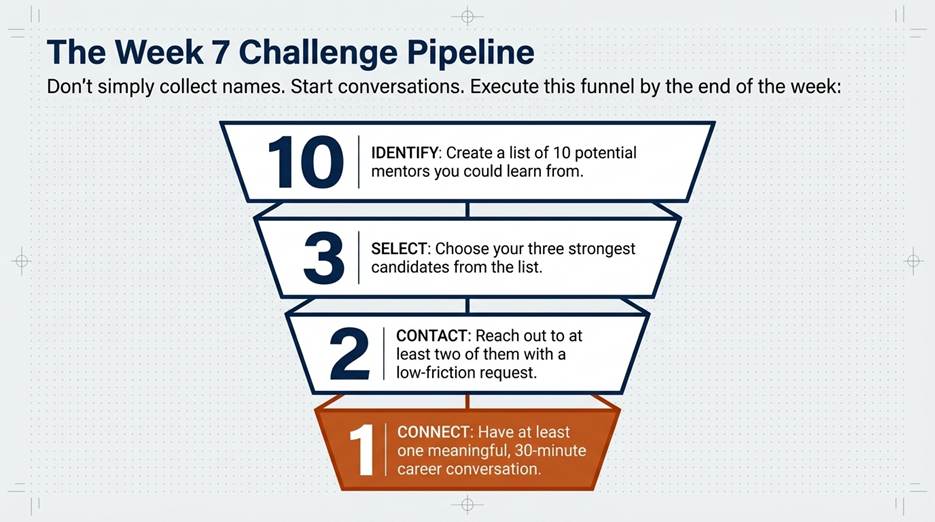
Start conversations.
This week:
10 → Identify | Find 10 potential mentors.
3 → Select | Choose your three strongest candidates.
2 → Contact | Reach out to at least two.
1 → Connect | Have at least one meaningful career conversation.
🔑 WEEK 7 TAKEAWAY
Your career can move faster when you learn from people who have already traveled the road.
Don’t search for someone who will tell you exactly what to do.
Find people who will:
Challenge your assumptions.
Expand your perspective.
Open your eyes to possibilities.
Help you avoid unnecessary mistakes.
And push you toward your next level.
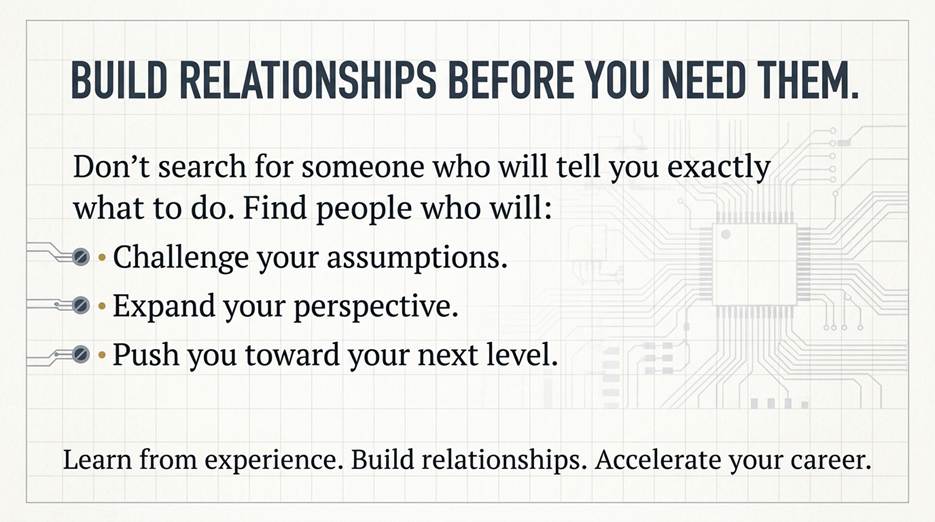
Build relationships before you need them.
🎯 WEEK 7 DELIVERABLE
MY CAREER ADVISORY CIRCLE
Mentor 1: ____________________
Area: Technical
Mentor 2: ____________________
Area: Career
Mentor 3: ____________________
Area: Leadership
My next mentor conversation: ____________________
One question I will ask:
“Based on where I am today, what is the one thing you believe I should focus on next?”
WEEK 7 → FIND MENTORS
Learn from experience. Build relationships. Accelerate your career.