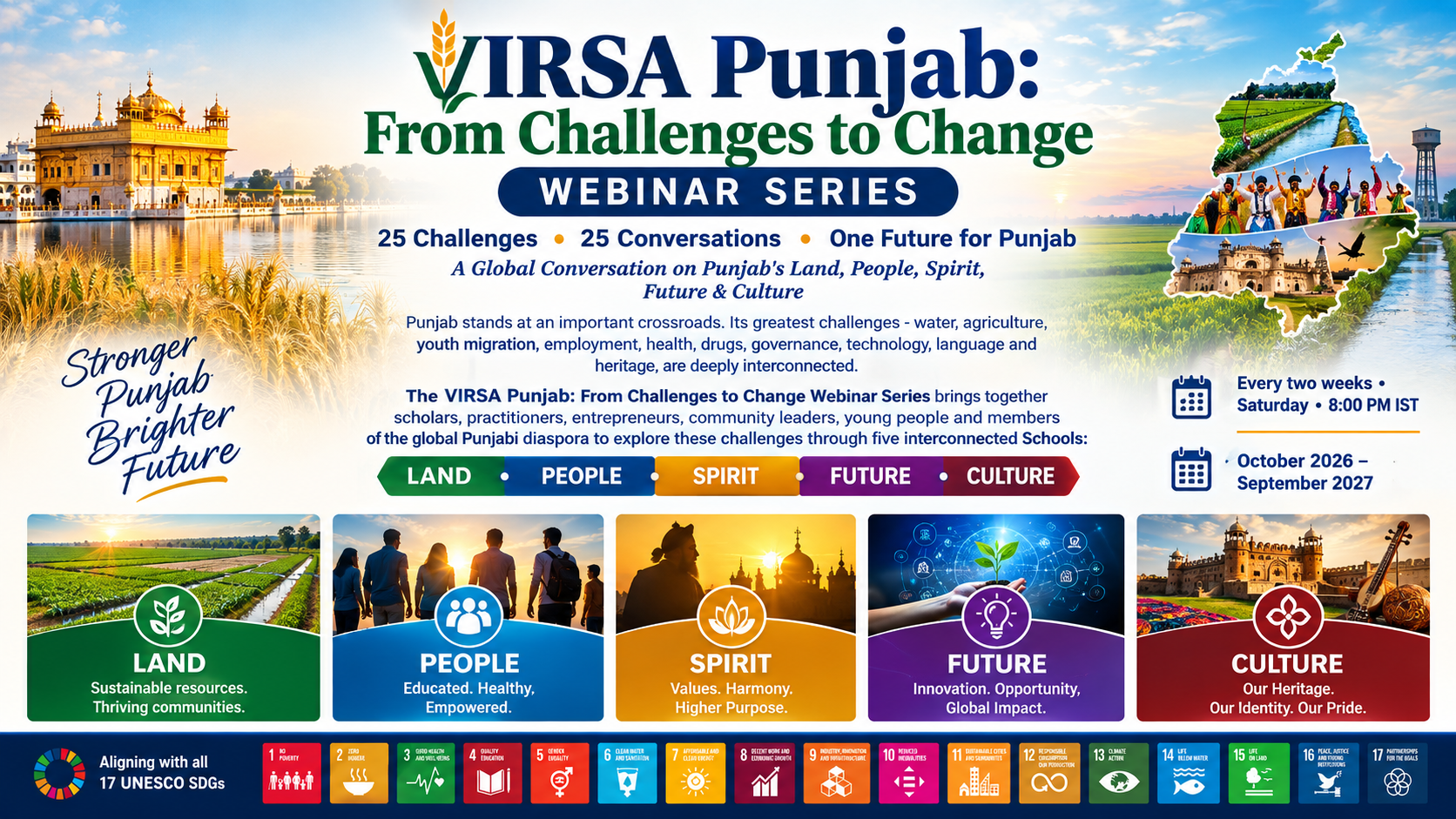
🎙️ Hear Dr. Samanpreet Kaur on WATER SECURITY
📅 Saturday, October 3, 2026
⏰ 8:00 PM IST (India) | 9:30 AM CST (USA)
🌍 Webinar #1 – VIRSA Punjab: From Challenges to Change
Punjab’s water story is changing and understanding the challenge requires science, data, innovation and action.
We are proud to welcome Dr. Samanpreet Kaur, Principal Scientist, Department of Soil & Water Engineering, Punjab Agricultural University, Ludhiana, as our featured speaker.
With 26 years of experience, Dr. Kaur’s work focuses on some of Punjab’s most critical water challenges, including:
💧 Groundwater depletion & sustainability
🛰️ Geospatial technology & remote sensing
🤖 AI applications in water management
🌱 Irrigation engineering
🔄 Artificial groundwater recharge
📍 Groundwater monitoring & modelling
With 225+ publications, major national and international research projects, and extensive work in groundwater management and irrigation, she brings decades of scientific knowledge to the conversation on Punjab’s water future.
ONE CHALLENGE. ONE CONVERSATION. ONE FUTURE.
VIRSA Punjab: From Challenges to Change is a unique international webinar series exploring 25 Challenges • 25 Conversations • One Future for Punjab, bringing together experts, researchers, practitioners and global voices to explore Punjab’s land, people, spirit, future and culture.
🔗 Learn more & explore the full series:
https://gndgu.com/events/virsa-punjab-from-challenges-to-change/
Join us. Listen. Learn. Question. Imagine.
Because Punjab’s future begins with understanding the challenges we face today.
Dr Samanpreet Kaur
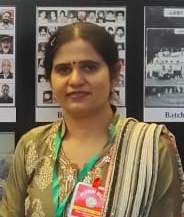
Principal Scientist, Department of Soil & Water Engineering, PAU, Ludhiana
Dr Samanpreet Kaur is Principal Scientist in the Department of Soil & Water Engineering at Punjab Agricultural University, Ludhiana, where she has served for 26 years. She took her B.Tech., M.Tech. and Ph.D. degrees, all in first division, from this University.
Her research addresses the groundwater crisis of Punjab through groundwater modelling, geospatial and AI applications, irrigation engineering and artificial recharge. Four of her recommendations have been approved by the Research Evaluation Committee; her geostatistical work on monitoring network design forms the basis of the 7.5 km monitoring-well spacing recommended in the Punjab Agriculture Policy 2023; and her scientific inputs on palaeo-channels underpin detailed project reports sanctioned by the Government of Punjab. She holds one Government of India software copyrights. She prepared the district irrigation plan for Hoshiarpur as part of the State irrigation plan team. She has authored over 225 publications, including 106 refereed papers, twelve of them in journals rated above NAAS 10, with an h-index of 20. She is Principal Investigator of five ongoing projects, among them the AICRP on Irrigation Water Management and the DST-FIST Geospatial Laboratory, and has completed fourteen others with ICAR, DST, NABARD, GIZ and the Indo-UK TIGR2ESS programme.
She is Principal Investigator of five ongoing projects, among them the AICRP on Irrigation Water Management, the DST-FIST State-of-the-Art Geospatial Laboratory, NRSC field stations for evapotranspiration measurement and an ISRO RESPOND project, and has completed fourteen projects with agencies including ICAR, DST, NABARD, GIZ and the Indo-UK-funded TIGR2ESS programme. She established the geospatial laboratory, an eddy covariance flux tower and the Alumni Relations Centre, the first of its kind in the University, and facilitated Memoranda of Understanding with the National Remote Sensing Centre and the National Institute of Hydrology, Roorkee. She has chaired the Departmental Research Committee for the past ten years and served the Alumni Association as Secretary and later Vice President.
She has received the Jawaharlal Nehru Award of ICAR for the best doctoral thesis in Natural Resource Management, the NAIP Fellowship to The Ohio State University, the ISAE Commendation Medal and the Dr M.S. Randhawa Best Book Award, and has been recognised among the twenty Eminent Women Scientists in Natural Resource Management. She has guided fourteen postgraduate students to completion, five of whom now hold positions/pursuing higher studies at institutions abroad. She took the initiative for starting the Ph.D. programme in Remote Sensing and GIS at the University, has taught 230 credit hours. She has delivered 85 invited lectures and organised 29 training programmes. She is currently a member of the Farm Irrigation and Drainage Systems Sectional Committee (FAD 17) of the Bureau of Indian Standards and Nodal Officer from the University for implementation of the State Water Reforms Framework, and has earlier served on the District Level Expert Appraisal Committee of the Ministry of Environment, Forest and Climate Change.